Bryce Dessner & Sō Percussion: Music for Wood and Strings (pt. 1)

Dessner

Dear Matt,

Let’s have a change of pace. This week, you’ll be listening to something brand new.

Bryce Dessner is the guitarist from The National (the band, not the newscast), a group that I think you and I have about equal experience with — that is, not much. However, Dessner has been on my radar for a while in his other capacity as a composer. He’s written music for the Kronos Quartet, Bang on a Can, and even the LA Phil. Nothing I’d heard of his really hit home — until this past May.

Music for Wood and Strings is a 35-minute composition for the New York percussion quartet Sō Percussion. Sō is a group with a similar spirit to our old friends Brooklyn Rider. They fall broadly under that nebulous umbrella of ‘art music’ — they’re a bunch of Yale grads — but they’ve got a sense of adventure and a penchant for working with composers on developing new repertoire. (I’m especially fond of their recording with Canadian composer Nicole Lizée.)

This collaboration with Dessner has the added dimension of being written for entirely new instruments. Dessner and the instrument maker Aaron Sanchez (from the DIY pop duo Buke and Gase) designed a contraption that they’ve creatively named the ‘chord stick.’ It’s kind of like an amplified hammered dulcimer that you’re meant to approach much more as a percussionist would than a guitarist. Sō strikes their four chord sticks with everything from drum brushes to the pink erasers at the ends of lead pencils.

I’m not going to say a whole lot more, because I’m still processing this music myself. I have to say, though: a few listens in, I’m totally sold. This is the best new music I’ve heard all year. You’ll recognize a distinct influence from minimalism, but composers of Dessner’s relatively recent vintage tend to use the innovations of people like Steve Reich and Michael Nyman as one ingredient in a more complex stew.

I think you’re going to like this. I’ve already recommended it to a few people, and I’ve only had positive responses. I wonder how your first impression will compare to mine?

— Matthew

M.I.A.: Kala (pt. 2)

Kala

Dear Matt:

This tweet notwithstanding, I can detect no connection between M.I.A. and Kate Bush. But hey, one’s ears are one’s own. Moving on.

I have never been much for subtlety. You will have gathered that by now. That tendency extends from my taste in rock to my preference of Beethoven string quartets. (Opus 132, please. Keep your 127.) So, M.I.A’s aesthetic is well within the ballpark of ‘stuff I tend to like.’ (Subtle as a landmine, indeed.) Kala’s great.

But, let me be totally honest: after a couple of listens, ‘Paper Planes’ still eclipses everything else on the album. You may find that disappointing, the same way I do when someone informs me that their favourite Jethro Tull song is ‘Aqualung,’ or their favourite Peter Gabriel song is ‘Sledgehammer.’

Why should that be disappointing, though? Once in a while, the slightly-left-of-centre (though not necessarily obscure) artists that thinky music people* listen to make a song that allows the rest of the world to get in on the joy. Isn’t that worth celebrating? Of course it is. That, for me, was a key takeaway of the most tiring ideological debate in pop culture over the last decade.

But, to write that just now, I had to subdue a tremendous amount of pathological geekiness and symphony-goer snobbery. Because, the fact is, the music that speaks most deeply to me speaks to a relatively small number of people. I’m under no illusions that there’s any superiority in that. But, some part of me can’t help thinking that when an artist does manage to conjure the secret sauce for a ‘Paper Planes’ or a ‘Sledgehammer,’ they sacrifice something that makes the bulk of their music so meaningful to the true believers.

And it’s entirely possible that I’m not equipped to be a true believer in this case. You entreated me in your assignment to engage with M.I.A.’s mashup aesthetic, and consider her as one of the first breakout artists of the digital age. And while I love mashups in concept, I suspect that some of the effect was lost on me in this case, since Kala appears to mostly reference stuff I’ve never heard of. The only references I caught were the Clash and the Pixies — the first only because you told me, and the second only because of Fight Club.

But, I’ve just realized that I’m doing that thing again where I make it seem like I enjoyed an album less than I did. I really enjoyed Kala, and I’ll definitely be checking out more M.I.A. One of the structural weaknesses in this project is that it can only ever be about first impressions. Ten listens from now, ‘Paper Planes’ might be my least favourite track on the album.

— Matthew

*These people are the worst. (Mea culpa.)

M.I.A.: Kala (pt. 1)

Kala

Dear Matthew:

If you’ll recall, I once posited on this blog that Kate Bush was the Seinfeld of female art-pop stars. (New readers: in context, this is more flattering than it sounds. I promise.) When I talked about the modern female art-pop stars she influenced, I mentioned Björk and Fever Ray, but mostly I was thinking of M.I.A. This week, you’ll be listening to her album Kala.

Mathangi ‘Maya’ Arulpragasam — get it? M.I.A.? — is a British-born Tamil who grew up in Sri Lanka during the outbreak of civil war, something that has underscored much of her artistic career. She makes a chaotic sort of electro rap pop type of music that is often highly political in nature. She also draws on many other genres from around the world, from dancehall to baile funk to Bollywood film scores. A trained visual artist, she’s also known for the striking visual elements of her music, including videos, fashion and art. Combine all of these traits, and you have someone almost destined to get huge if she happened to be around at the advent of the digital music revolution. And hey, guess what?

Her first album, Arular (named for her father, a prominent member of a militant group called EROS), caught the ears of all the hip music bloggers when it came out in 2005, right around when music bloggers were starting to become a thing. But it wasn’t until Kala (named for her mother) that she really blew up, and blow up she did — you are hopefully at least passingly familiar with the Clash-sampling mega-hit ‘Paper Planes‘. Kala is also when she first teamed up with producer Switch, and also features further collaborations with Diplo, who was still relatively unknown at the time (and also her boyfriend). In contrast to the comparatively stark beats of her bedroom-produced debut, it’s a lush, worldly collage of sounds — owing to the fact that it was literally recorded around the world. It’s a bombastic, idiosyncratic, in-your-face record, and it solidified her place in the pantheon of internet pop stars. It was probably about as successful as you could ever ask a ‘difficult sophomore album’ to be.

I’ll be honest: Kala is not my favourite M.I.A. album*. But this assignment isn’t about listening to her ‘best’ album — this is about the context. I want to hear your thoughts on one of the first big albums of the digital era, an album that arguably couldn’t have been made in any other era. I want you to really dig into Kala‘s mashup aesthetic. I want you to see how many musical allusions, references and samples you can identify in its sonic collage, and to know how you feel about them. And, of course, I want to know if my Kate Bush analogy is grounded in any sort of reality.

M.I.A. isn’t for everyone. She’s about as subtle as a landmine, and her politics certainly rub a lot of people the wrong way. But her music is like nothing else out there, and that’s more than most can say. Even if you don’t love it, I hope you at least find it interesting.

— Matt

* For the longest time that was Arular, but it’s been recently supplanted by the extremely good Matangi. I’ve warmed up a lot to /\/\ /\ Y /\ over the years, too. In fact, now that I think about it, Kala might actually be my least favourite M.I.A. album. But again! Not the point.

Jethro Tull: Thick as a Brick (pt. 2)

TAAB

Dear Matthew:

A mutual friend of ours, Syrup Trap editor Nick Zarzycki, once made an observation that has really stuck with me: he argued that the best comedic films, at least in terms of laughs per minute and broad popular acclaim, are almost always parodies.

I think he’s probably on to something. If you take a look around the internet for what people think are the best comedies of all time, Airplane!, Life of Brian, Blazing Saddles and their ilk are usually in the mix, and pretty near the top, too. And when I think of it, a lot of my more modern favourites are very much in the same mold — Hot Rod and They Came Together and Kiss Kiss Bang Bang are some that spring immediately to mind, and there are definitely others.

If you think about it, it makes a lot of sense. Genre spoofs work well because the audience knows the material — you don’t have to do a lot of world-building or characterization, because you’ve already got a whole box of tropes and archetypes to work with. Since they’re spoofs of whole genres, they tend to age reasonably well, unlike spoofs of specific films — compare the staying power of the aforementioned Blazing Saddles with that of, say, Spaceballs.

The other thing about movies like this is that they tend to rate very highly with self-proclaimed ‘comedy aficionados’*. I think this is because, unlike a wholly original film, the story doesn’t really matter; in a genre parody, the plot is basically just a vehicle for jokes. In a way, the genre parody allows for filmic comedy in its purest form, because you aren’t writing anything that isn’t either the setup for, or the punchline to, a joke. You don’t have to sell the audience on a complicated story or complex characters — it’s just all jokes all the time.

I think a similar effect is probably why Thick as a Brick works so well. But the thing about TAAB is that it’s almost too good of a parody. Let me explain what I mean.

To reference Mel Brooks for the third and hopefully last time this article, TAAB suffers from a sort of reverse Springtime for Hitler effect. It’s intended to be a spoof of all of the most ridiculous aspects of prog, but in doing so, it embodies them so well that I, an admitted prog neophyte, would be hard-pressed to pick this out as a parody on first listen if I didn’t already know. It would be very easy for the less studious listener to mistake it for a completely serious endeavour — and indeed, some background reading on the album suggests that many did and still do.

The extremely dangerous internet time-sink TV Tropes refers to this effect as Poe’s Law. The law, roughly stated, is that parodies of extreme ideas/things are often mistaken as being sincere, and that sincere expressions of extreme ideas/things are often mistaken as parody — and paradoxically, the more extreme the idea/thing is, the more likely the confusion. This is why you get people who think that Stephen Colbert is actually a hardcore right-wing pundit, why people still think that Jonathan Swift actually condoned eating the Irish, why the Yes Men are able to get away with as much as they do, and one of the many reasons why LiarTownUSA is possibly the best thing to happen to Tumblr.

So, while I certainly got a kick out of the record, I expect my experience was similar to that of yours with Mr. Oizo — which is to say that I get it, but without a more deepseated love for the material being satirized, I don’t know that I’ll ever truly appreciate it on the level that you do. In my defence, it’s a pretty tall order to appreciate TAAB on the level that you do, but I’m still sorry to let you down.

But for what it’s worth, I did very much enjoy this pondering of the nature of parody that TAAB inspired. That, and the album sleeve is outstanding.

— Matt

* These people are the worst.

Jethro Tull: Thick as a Brick (pt. 1)

TAAB

Dear Matt,

So far in this project, I’ve endeavoured not to advocate too hard for the albums I’ve assigned you, to give you a bit more room to say your piece. I have mostly failed. This time, though, I’m throwing that whole notion to the wind because there’s no point in even trying.

There was a time in my life when I tried to purge myself of favourites. I’d say I had no favourite movie, no favourite book, no favourite composer, no favourite album. The idea was to embrace the vast and untameable diversity of stuff out there and not reduce it to a select few exemplary works. Or some bullshit like that.

Needless to say, it didn’t take. I was lying to myself the whole time: I have a favourite everything. My favourite movie is Brazil. My favourite book is At Swim-Two-Birds. My favourite composer is Mahler. And, beyond a doubt, my favourite album is Jethro Tull‘s Thick as a Brick.

People are often taken aback when I tell them that, because Tull is widely seen as a bit of a novelty act: that rock band with a flute player. But Ian Anderson’s flute playing doesn’t actually have that much to do with why I love Jethro Tull. Anderson isn’t just the guy who invented rock flute playing. He also has one of the most boundless and versatile imaginations in rock. The rest of the band is fantastic too, but they’re utterly dominated by Anderson — in a way that King Crimson, for instance, has never quite been dominated by Robert Fripp.

That’ll have to do as a primer on what Jethro Tull is, because Thick as a Brick itself requires quite a lot of explanation. The famous backstory goes like this: Tull’s major commercial breakthrough came in 1971 with ‘Aqualung,’ the title song from their fourth album. The album itself got a lot of attention, and some critics called it a concept album, because it had a couple of major lyrical themes running through it.

This was news to Anderson, who saw Aqualung as ‘just a bunch of songs.’ Moreover, concept albums were the province of prog rock, which Anderson regarded with a certain amount of suspicion. He saw Jethro Tull as an unusually adventurous blues-rock band — as different as you can get from the psychedelia-tinged pastoralism of Genesis, Yes, and early King Crimson.

So, when it came time to record the followup to Aqualung, Anderson decided to announce that difference in a characteristically outlandish way. He would produce ‘the mother of all concept albums’: a sprawling parody that would take all of the trends in progressive rock — longer and longer songs, circuitous and cod-philosophical lyrics, elaborate packaging — far beyond their logical conclusions.

The resulting album came with a satirical newspaper that took longer to produce than the actual music. It possessed a sly backstory wherein the album’s lyrics were written by a precocious (and fictional) eight-year-old named Gerald Bostock. And the record itself consisted of only one song, which spanned the entire length of the album. The fact that the technology of the time functionally prohibited this (you have to flip the record over mid-song) only adds to the absurdity of the premise.

It even manages to shoehorn a bit of elitism into the equation. The first line drips with open disdain for the listener: ‘Really don’t mind if you sit this one out.’ It would be offensive if it were serious.

But, the whole affair has ‘satire’ written all over it. Anderson has always claimed that he was basically taking the piss with this album, and that presumably spared him a great deal of vitriol when the early punks came along five years later. You seldom hear Jethro Tull cited as one of the key offenders in discussions of 70s bombast. They were just having a laugh, after all.

But here’s where that narrative falters: Thick as a Brick is the best progressive rock album ever made. It is bursting with energy, it is structurally ingenious (with almost all of the section transitions being based on the opening riff), and the lyrics are just as trenchant in their critique of England’s class system as they are in their parody of Pete Sinfield. And it’s fun. It’s just fun.

I mean, that word ‘best’ is subjective, clearly. But, among prog fans, rock fans, critics and everybody else, the idea that Thick as a Brick is in the top tier of prog masterpieces is completely uncontroversial. This, in spite of the fact that it’s ostensibly a piss-take.

And that is why you are listening to this album at this point in our correspondence. When you described Mr. Oizo as “taking the piss out of [dance music] and its fans — while still producing outstanding examples of it,” my mind immediately jumped to Thick as a Brick.

Your experiences with Van Der Graaf Generator, Magma and King Crimson should be enough to demonstrate what prog is like in sincerity mode. So, what do you think? How much irony is there in Thick as a Brick? And do these trifling matters of authorial intent make any difference at all?

And, most importantly, do you like it?

— Matthew

P.S. I once proved that Ian Anderson is a good singer, using math. You know, just in case you’re not sure how far my loyalties extend.

Mr. Oizo: Lambs Anger (pt. 2)

lambsanger

Dear Matt:

Well, this was an aesthetic experience. What a pity that website is getting torched. Such a loss.

I must congratulate you on your expert guidance into the world of Quentin Dupieux. This could easily have been a disaster — there’s something perverse about recommending an album that parodies French house, when the recommendee’s experience with that genre is basically limited to Daft Punk’s Discovery. But Lambs Anger worked for me. And I think part of the reason why it worked was because because Rubber got me into the right headspace for it.

I actually watched Rubber in its entirety, because how can you not? Metafictions like this are catnip to me. (See also: Mulholland Drive, Holy Motors, Adaptation). I came for the self-reflexive genre critique; I stayed for the unexpected joy of watching a weirdly sympathetic anthropomorphized tire blow shit up.

Still, that opening is the lynchpin of the whole thing, isn’t it? I think it’s especially notable that our self-aware police lieutenant frames the movie as an homage rather than a satire. (I’m sure the two can overlap. In this case, though, they don’t.) Rubber observes that much of what happens in movies happens for the sloganistic “no reason.” But, instead of suggesting that there’s something wrong with that, the movie concludes that it’s the natural order of things and indeed, that it’s the “most powerful element of style.” And then, Rubber proves its point by being incredibly fun to watch.

I’m quite certain that there’s something similar afoot in Lambs Anger. You mentioned in your assignment that there’s an element of piss-taking in what Mr. Oizo does. (And, frankly, if he is just punking the scene, it’s working. Have you read the Pitchfork review of this? Daaaamn.) But, as you well know, that’s not the whole story. Dupieux has mastered a concept that I like to hammer on about: the qualities that make a thing patently ridiculous or flawed can (and in many cases, should) be construed as positive to the overall experience of that thing. (I’m going to link to Sontag’s “Notes on Camp” again, because any opportunity etc. Though I should stress that Dupieux’s self-awareness disqualifies him from inclusion in that category right from the outset.)

That notion of just owning your idols’ ridiculousness is the explicit theme of Rubber. In Lambs Anger, it’s more implicit, but it’s still there. It is also the theme of Jethro Tull’s Thick as a Brick, which is an album I only invoke when I’m in a really good mood.

A final observation: at one point in Rubber, there’s a bedraggled hitchhiker walking along the desert road. Upon investigation, I discovered that he’s the co-composer of the movie’s score, and a member of Justice — who you referenced in your post. He’s also wearing a Yes t-shirt. I am going to allow myself one of my occasional lapses into mysticism and take this as a sign that your next assignment needs to be another prog album.

Guess.

Which.

One.

— Matthew

Mr. Oizo: Lambs Anger (pt. 1)

lambsanger

Dear Matthew:

Sorry for a third straight week of bleeps and bloops, but bear with me — this one is somewhat time-sensitive.

This is another multi-part assignment. But don’t worry — the parts are pretty small. The first part of the assignment is to watch this:

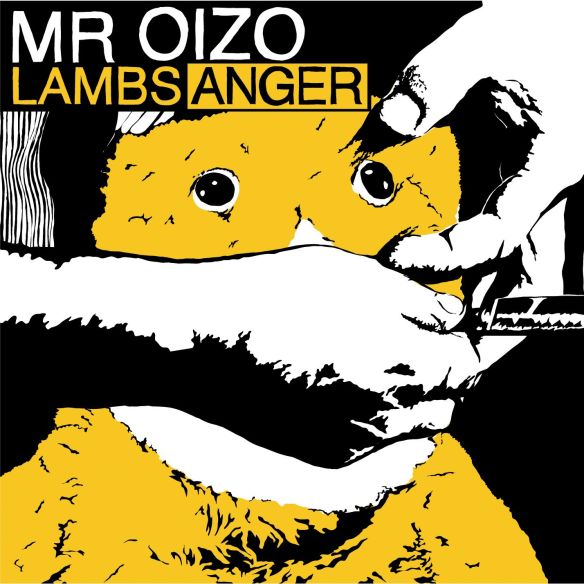
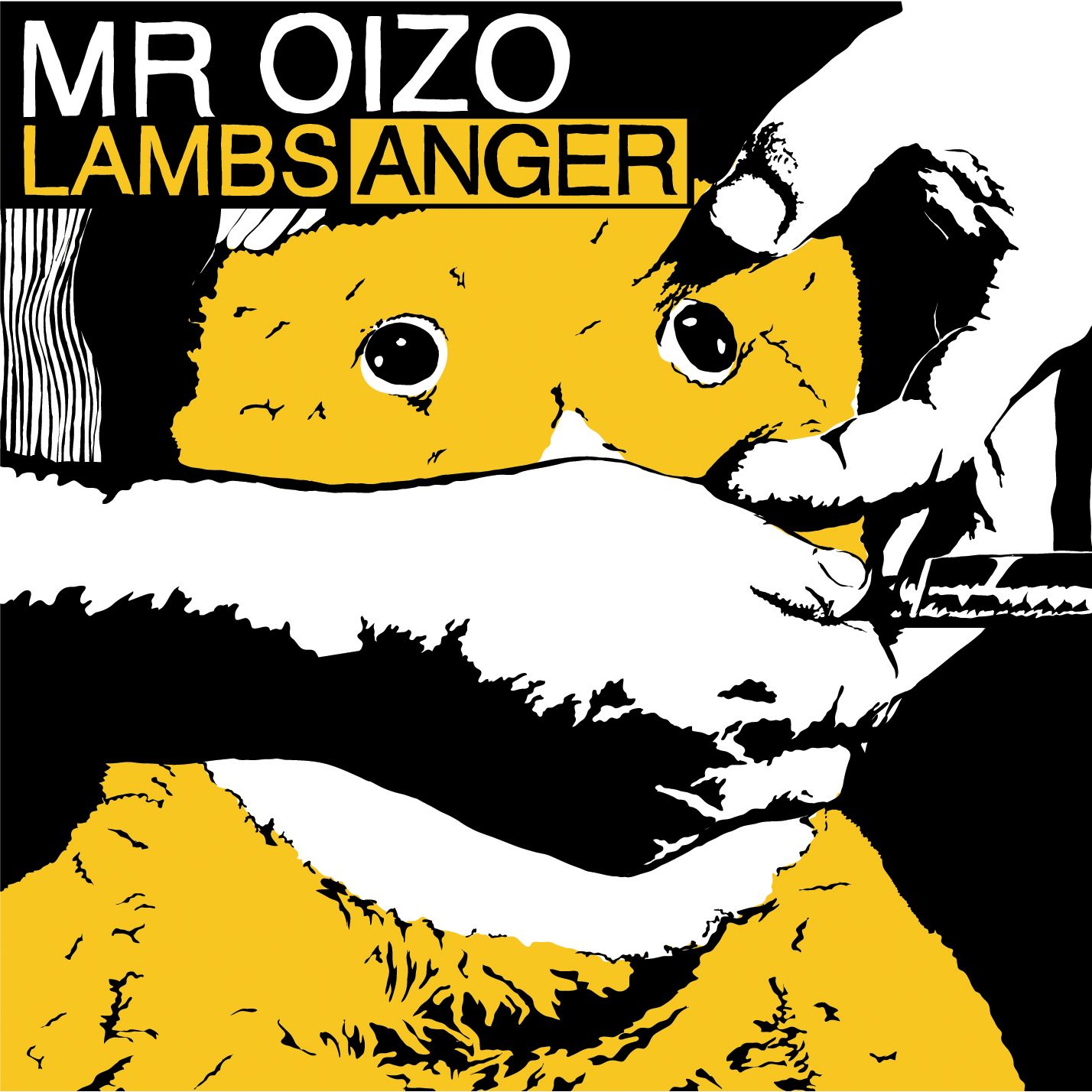
That’s the opening scene of a 2010 film called Rubber. It’s about a tire that comes to life and starts killing people with its mind. It was written and directed by French filmmaker Quentin Dupieux, and it’s a better summary of his approach to art than I could ever hope to write myself. You see, in addition to making films, he also makes music under the name Mr. Oizo (pronounced ‘oiseau’, as in the French word for bird), and this week you’ll be listening to his 2008 album Lambs Anger.

If the Rubber clip and the blatant Luis Buñuel reference weren’t enough to spell it out, Dupieux deals heavily in the absurd and the surreal. His only real ‘hit’ was the 1999 track ‘Flat Beat’ — the video, directed by Dupieux, features the yellow puppet and de facto Oizo mascot Flat Eric, who graces the cover of Lambs Anger. Dupieux eventually fell in with the Ed Banger crew, a French record label and loose collective of electro producers who rose to prominence in the mid-2000s (mostly on the backs of the band Justice). His early music was already pretty left-field, but when he joined the Ed Banger roster, his sound shifted noticeably toward more club-friendly four-to-the-floor electro sounds — but his surreal sensibilities became even more pronounced.

That’s what’s so fascinating about Dupieux as a producer: he really does know how to make good dance music, but it’s always done with his tongue planted so firmly in his cheek its a wonder he can still talk. His entire career, especially since joining Ed Banger, has essentially been about taking the piss out of the genre and its fanswhile still producing outstanding examples of it. His production is ridiculous to the point that it feels like he’s playing a game of chicken with the scene, seeing how far he can go and still have people call it dance music. (I love it, obviously.)

Lambs Anger is Dupieux’s first full-length release on Ed Banger, and it’s probably the best jumping-off point for really getting into the Mr. Oizo headspace. Like his films, his music has a very strong sense of continuity to it — a canon, even. Repeated phrases and hooks, synthesized speech, Uffie, some of the most obnoxious techno music you’ve ever heard — Lambs Anger has it all. It even manages at times to actually be pretty listenable. It’s even got that rarest of rarities: a good hip-hop cover. This is peak Oizo.

I’m not going to lie: this is going to be a challenging listen for you, especially given what I know of your opinion of electronic dance music. But given what I know of your taste in art more generally, I think you’ll at least be able to appreciate the ethic with which Dupieux is approaching the genre. He’s making a new pair of clothes for the emperors of EDM. He’s drawing a musical moustache on the Mona Lisa. He’s the DJ of Dada.

Why?

No reason.

— Matt

PS: I almost forgot the third part of your assignment! After you’ve listened to the album, head on over to http://oizo3000.com, and just experience it. If you enjoyed Lambs Anger, great! You can download his EP Stade 3 for free from the website, and it’s a good next step. If not, poke around the website anyway — according to his Twitter, he’ll be shutting the website down for good soon. It’s a damn shame.

PPS: Even if the music doesn’t speak to you in the slightest, you might still enjoy his films. The aforementioned Rubber is a good start. If the music does speak to you, Id suggest checking out Wrong Cops at your earliest convenience.

King Crimson: Red (pt. 2)

red

Dear Matthew:

Okay, maybe there is something to this prog stuff after all.

Don’t get too excited. I wasn’t blown away like I was by the Baroque accordions. I wasn’t nailed to my seat like I was by Brian Eno. In fact, ‘Red’ and ‘One More Red Nightmare’ are the only two songs I was really, really into. But hey, baby steps, right?

If this album is any indication, I can definitely see why you suspect that NoMeansNo are King Crimson fans. Indeed, if you like the song ‘Red’, I suggest you immediately check out some of the proggier NoMeansNo, like Why Do They Call Me Mr. Happy? One of my favourite things about this project has been discovering the foundations, or in some cases, what are essentially early versions of more modern music that I love, and I can certainly see why ‘influential’ is one of the most popular adjectives used to describe King Crimson.

You might be onto something with intuitive appreciation of music. I mean, I try to have an open mind, but realistically, I usually know if I’m going to like a song with the first few seconds — or if I’m going to really like it, anyway. To use a crude metaphor, it’s a bit like sex appeal: you usually know right away if you’re attracted to someone, but it’s often hard to pick out a specific reason why. It’s intuitive. And sure, there are people you warm up to over time, but with the most compelling people, it’s instantaneous.

So there’s definitely a lizard-brain level of liking music, but I’m becoming increasingly aware of how much a band’s — to use a word that accurately conveys the idea I’m talking about but makes me want to throw up a little — brand affects how much people like them. Maybe a big part of why I could never get into prog was all of the pretense — the stuff you pointed out that King Crimson doesn’t do. Would I have liked them as much if I’d gone into the album not knowing that? I’d like to think so, but you never know. (In my own defense, I can usually put aside ‘brand’ considerations once I hear the actual music itself; generally the most it does is keep me from listening in the first place.)

One last thought: in terms of contemporary bands, your description of how the band as a Fripp-powered engine that looks completely different every time it’s reassembled reminds me a lot of Gorillaz. Gorillaz is, at its core, a Damon Albarn solo project with art design by Jamie Hewlett, but it features so many guest musicians and producers that every album almost sounds like a different band. Dan the Automator’s influence is all over the self-titled record, and Danger Mouse is definitely on display on Demon Days. (I believe Plastic Beach is produced by Albarn himself.) In fact, now that I think of it, this sort of band is actually pretty common, if not quite to the same extent: Nine Inch Nails is Trent Reznor, LCD Soundsystem is James Murphy, Queens of the Stone Age is Josh Homme, etc.

Anyway, congratulations — I didn’t completely hate a prog album!

— Matt

King Crimson: Red (pt. 1)

red

Dear Matt:

Time for prog rock round three.

King Crimson is for some reason the coolest of the classic prog bands. You seem to have picked up on that yourself, given your opening remarks in your Magma response. I have a few theories as to why that is. Bullet points!

  • It could be because they were first. Their debut, In the Court of the Crimson King is widely regarded as the first proper progressive rock album, which would serve as a model for Yes, Genesis and their ilk.
  • They avoided certain dated genre tropes. They never made a concept album. They didn’t mount over-the-top stage extravaganzas. They generally didn’t dress like this.
  • Robert Fripp wasn’t a hippie. He was, and is, an aloof intellectual who’d rather hang out with Brian Eno and Terre Roche than Rick Wakeman and Greg Lake (who he reportedly once threw out of a limousine).
  • They constantly reinvented themselves. The first eight King Crimson albums all feature different lineups. Fripp had a tendency to dissolve the band and reconvene it with entirely new members and a dramatically different sound.

That last point brings up something important: King Crimson isn’t really a band in any meaningful sense. They’re a series of bands, at best — with a leader in common. Fripp has described King Crimson as ‘a way of doing things,’ which is just one example from his lexicon of strange ways to talk about his band. King Crimson doesn’t break up; they ‘cease to exist.’ And they don’t re-form; they ‘return to active service.’

Picking an album to assign was no small task, given that not many of them have much in common. In the Court is probably their most revered album. But, it’s also the wellspring of a particular kind of prog that I know you don’t enjoy. Discipline, perhaps? Nah, too easy. It’s practically Talking Heads with polyrhythms.

Red, then. This version of King Crimson, my personal favourite, made three albums in ‘73/’74, of which Red is the last. True to form, Fripp couldn’t maintain a steady roster for all three albums: they lost their auxiliary percussionist after the first and their violinist after the second. So, on Red, the band contains three official members: Fripp on guitar, John Wetton on bass and vocals, and Bill Bruford on drums. This is the leanest that King Crimson would ever get, although the album features guest performances by a number of ex-Crimson members on various orchestral instruments.

I won’t get into the music on the album too much: I’ll leave that to you again. I can’t resist a few remarks, though. More bullet points!

  • “Providence” was recorded live. It’s one of the band’s famous free improvisations. Their willingness to just go out onstage and jam is one of the things that sets them apart from many of their prog contemporaries, who tended to stick to the script.
  • “Starless” is, for my money, one of the five or six best tracks of 70s prog. It takes a completely unique and surprising approach to making a 12-minute-long song.
  • Astonishing though it may seem, Fripp is possibly the least technically accomplished member of the band at this point. Bruford is the best jazz drummer who barely ever played jazz (he came to Crimson straight out of Yes), and Wetton is a true bass virtuoso, although he gives a fairly restrained performance here.

Okay, I was going to try to be finished at this point. But, given your response to the prog you’ve encountered so far, I do have just a bit more to say.

People often assume, as you have at times in the course of this blog, that prog fans enjoy this music primarily on an intellectual level because, to quote you back at yourself, ‘it’s very technically impressive that you can play in weird keys and modes and flawlessly stick to bizarre time signatures.’ And, I’m sure there are fans out there for whom that’s the primary appeal. Certainly, complexity and technical proficiency are factors that enter into every defence of prog that I’ve ever read.

But, I’ve always found that defense a bit self-defeating, because for most listeners, complexity and technical proficiency are not values in themselves — nor are they necessarily even discernable. And I don’t actually think that those are really the reasons why prog appeals to most of its fan base. I think that it’s like any other kind of music: some people just respond to it intuitively, and others don’t. If this album doesn’t provoke that kind of intuitive response from you, I’m not sure there’s any prog that will. (Which doesn’t mean that I won’t keep trying, naturally.)

My challenge to you as you listen to Red is the same challenge that the MC offered the audience at the Magma concert we attended: don’t try to intellectualize this music. Contrary to its Apollonian image, that is not what it’s for. There are bits of this album that are in 13/8 time. Do not misconstrue that as being ‘the point.’

I await your response with even more anticipation than usual.

— Matthew

The Micronauts: Bleep to Bleep (pt. 2)

bleeptobleep

Dear Matt:

I’m afraid I am about to fulfil your fear about this response: that I may be entirely indifferent to the Micronauts.

I dunno, man. I’m at a loss. Remember when you didn’t like Godbluff, but you didn’t hate it either, and you kind of wished you had? That’s the situation I’m in with Bleep to Bleep. But, unlike Godbluff, this album doesn’t seem to me like the sort of music that’s even supposed to provoke a strong reaction. It’s the kind of music I tend not to have much to say about. It’s the kind of music that I might forget I’m listening to, and when I remember, I’m slightly annoyed. It’s the kind of music where, if it were playing in a store, I might leave sooner.

Obviously, I’m completely wrong about this: more on which later.

My favourite part of Bleep to Bleep was the track ‘Bleeper_0+2,’ a pretty straightforward noise track, with no beat. And that’s basically what I liked: it offered some respite from the merciless beat that otherwise pervades the entire album. When I started writing this post, I was worried that I would come off as hypocritical for critiquing the album’s sameness — the quality that you see as the source of its fascination — when I’m a fan of Steve Reich. But, there’s a fundamental difference between the Micronauts’ minimalism and Reich’s. Both employ ‘small amounts of musical material animated by obvious patterns,’ as I (inadequately) defined minimalism three posts ago. But Reich’s obvious patterns drive the music towards gradual change. The Micronauts’ patterns do not. Bleep to Bleep changes constantly, sure. But it doesn’t go anywhere. I had a theory teacher once, who pointed out that Reich’s most substantial gift was knowing when a musical idea would outstay its welcome. I would not personally say the same of the Micronauts.

As I’ve said before, I don’t enjoy disliking things. My philosophy is that if I don’t find something to admire in a piece of music, it must say more about my liabilities as a listener than the musicians’ shortcomings as artists. There’s a reason I’ve chosen to think that way: it’s self-evidently better to like more music than less music. Selectivity is for chumps. And if I put the onus on myself to appreciate a piece of music on its own terms, rather than on the musician to produce something that I can approach on mine, I’m more likely to enjoy more music. Plus, I’m inclined to think that it might make me a more empathetic human being, which is a win for everybody around me. (It may also explain my increasing tendency to write about myself instead of the music that you assign. Sorry about that.)

I remain frustrated that I haven’t been able to find a way into Two Fingers or the Micronauts. The fact that these are artists that you love makes it worse because it confirms that they can inspire the kind of nerdy joy that is essentially what I live for.

So, I’d like to make a proposition. If we’re still plugging away at this correspondence in a year or so, maybe we can take a week or two and just look back on a couple of albums that we haven’t liked. Because, how gratifying would it be to find that we’ve become better, more open music listeners over the course of this project?

— Matthew